Download Webflow CMS to HTML With a Complete Export Guide
If you love designing in Webflow but need a budget-friendly, high-performance, and portable way to deploy your site, exporting your Webflow CMS to static HTML is the answer. In this complete guide, you will learn how to turn your Webflow site — including CMS collection pages — into a clean, fast, and host-anywhere static bundle. We will use ExFlow, a dedicated Webflow Exporter and Webflow Downloader that simplifies the process and adds pro-level automations like Git, S3, and FTP sync.

Why convert Webflow CMS to HTML?
- Save money if Webflow hosting is too expensive for your needs by self-hosting static files.
- Speed and security: static sites are fast by design and have a smaller attack surface.
- Portability: own your code; move hosts anytime.
- Flexibility: integrate with your stack, CDNs, or CI/CD.
What does Webflow CMS to HTML actually mean?
Exporting your site creates a static snapshot: HTML files for each page, plus CSS, JS, images, and media. Webflow’s native exporter does not include CMS collection pages. That is where ExFlow comes in — it exports all pages (including CMS) so you can host your Webflow to Static without losing content.
Exporting your site creates a static snapshot: HTML files for each page, plus CSS, JS, images, and media. Webflow’s native exporter does not include CMS collection pages. That is where ExFlow comes in — it exports all pages (including CMS) so you can host your Webflow to Static without losing content.
Meet ExFlow: the easiest Webflow Exporter for full-site static downloads
ExFlow is a purpose-built Webflow Downloader that turns any Webflow/Squarespace/Framer site into a portable static package. It is perfect when you want to Download Webflow CMS to HTML, remove the Made with Webflow badge, and deploy anywhere.
ExFlow is a purpose-built Webflow Downloader that turns any Webflow/Squarespace/Framer site into a portable static package. It is perfect when you want to Download Webflow CMS to HTML, remove the Made with Webflow badge, and deploy anywhere.
Key highlights:
- Export all pages, including CMS collections and pagination
- Export CSS, JS, images, and media assets
- Set pages to .html extension automatically
- Remove the Made with badge
- Add custom script.js and style.css files
- One-click sync to S3, Git, or FTP
- Optional hosting on ExFlow servers with unlimited bandwidth and custom domains
Get started here: https://exflow.site
Step-by-step: How to download Webflow CMS to HTML with ExFlow
- Prep your site
- Publish your Webflow site so all public pages are accessible.
- Verify collection templates and lists are publicly reachable.
- Clean up 404s, broken links, and pagination settings.
- Enter your site URL
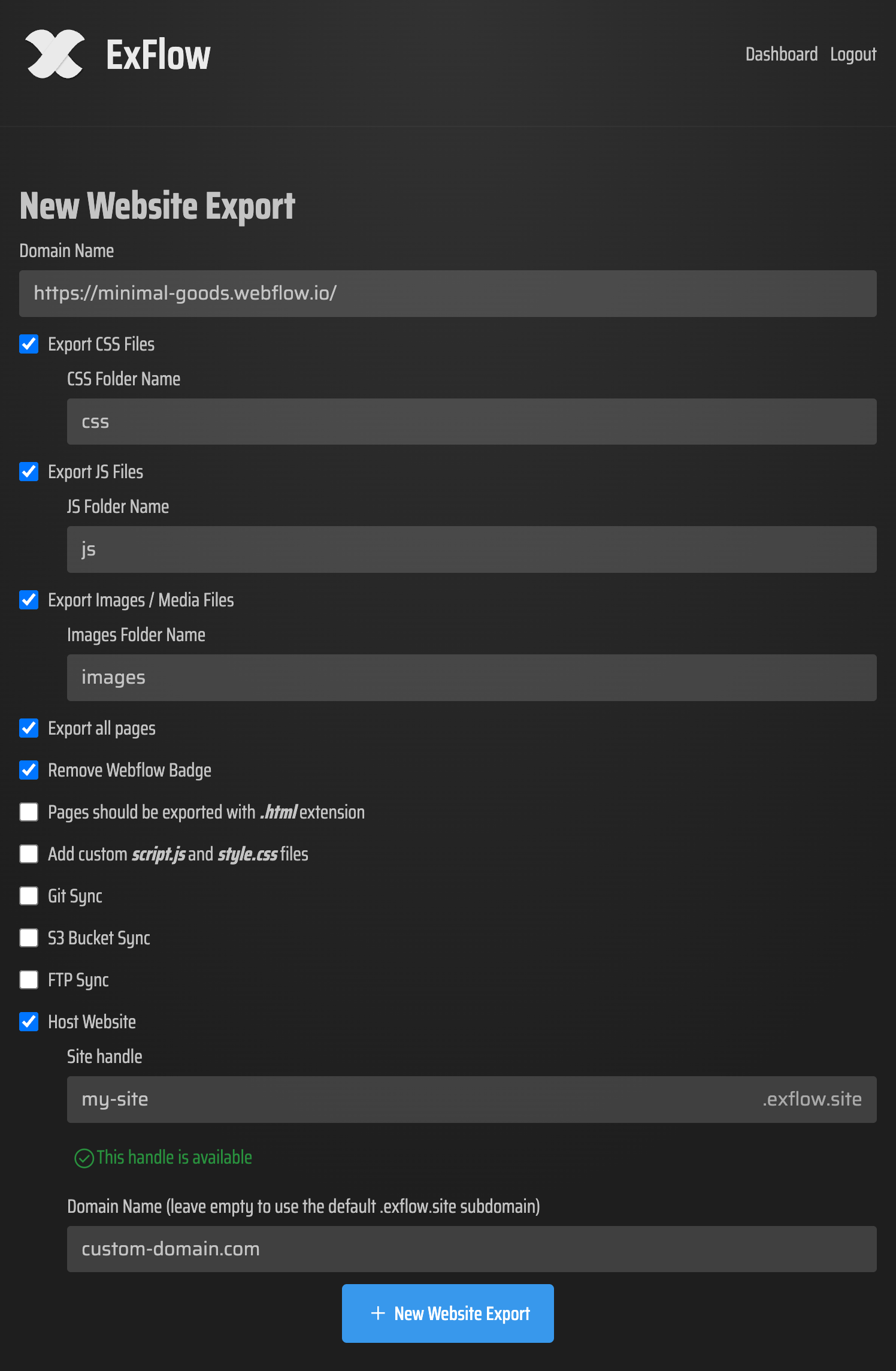
- Visit https://exflow.site and paste your site’s public URL.
- Choose export settings
- Check export CSS files, export JS files, and export images/media.
- Toggle export all pages to include CMS pages that Webflow’s native exporter misses.
- Select pages should be exported with .html extension.
- Optional: remove the Made with badge.
- Optional: add custom script.js and style.css to streamline post-export edits.
- Configure sync (optional)
- If you want auto-deploys, add Git, S3, or FTP credentials so ExFlow can sync your bundle after each export. These credentials are sensitive — only add them if you intend to sync. You can always skip and just download a ZIP.
- Start the export
- ExFlow crawls your site, resolves assets, and includes CMS pages.
- For large sites, allow time for asset gathering and pagination.
- Download the ZIP (or auto-sync)
- When complete, download the static bundle or let ExFlow push it to your target via Git/S3/FTP.
- Inspect locally
- Unzip the package and open index.html in your browser.
- Spot-check collection pages, images, and interactions.
- Adjust for static hosting (if needed)
- Forms: switch to a static form service (e.g., a serverless form endpoint).
- Search: use a client-side search library or a hosted search.
- Redirects and 404: configure these at your host/CDN.
Typical folder structure
/ (root)

  index.html

  /about.html

  /blog/

    article-1.html

    article-2.html

  /assets/

    style.css

    script.js

    webflow.js

  /images/

    hero.jpg

    logo.svg
Hosting options after export
- Host on ExFlow: The fastest path — enable hosting during export and serve directly from ExFlow with unlimited bandwidth and custom domain support. Check it out at https://exflow.site
- Amazon S3: Use ExFlow’s S3 sync, enable static website hosting on the bucket, and point your domain via CloudFront for global speed.
- Git + Pages/Netlify: Sync to Git, then deploy via GitHub Pages, Cloudflare Pages, or Netlify for automated builds.
- FTP to a traditional server: Provide FTP credentials in ExFlow and publish in one click.
Watch it in action
- Export a Webflow Site for Free + Badge Removal (Webflow-Exporter): https://www.youtube.com/watch?v=38hVzKheSvs
SEO and performance tips for static Webflow sites
- Use a CDN for images and media to reduce TTFB.
- Add rel=canonical tags if you mirror content across environments.
- Preload key fonts and critical CSS where appropriate.
- Generate a static sitemap.xml and robots.txt for indexing.
Common questions (and quick answers)
- Will CMS content keep updating automatically? Not without re-exporting. Use ExFlow’s Git/S3/FTP sync to automate scheduled exports when your content changes.
- Do interactions and animations work? Yes — your CSS/JS files are exported, so most Webflow interactions continue to work in static form.
- What about login-gated features? Static sites do not support native authentication. Use external auth widgets or a headless approach if required.
- Is this a Webflow alternative? Design in Webflow, deploy elsewhere. For teams finding Webflow hosting too expensive, ExFlow offers a Webflow to Static path that gives you cost control and full portability.
Why ExFlow over generic downloaders?
Tools like HTTrack can struggle with modern Webflow/Squarespace/Framer sites — complex animations, pagination, and dynamic content often break. ExFlow is tuned for these builders, handling CMS pages, asset resolution, and badge removal reliably. It is a true Webflow Exporter built for designers and developers who need predictable, production-ready output.
Tools like HTTrack can struggle with modern Webflow/Squarespace/Framer sites — complex animations, pagination, and dynamic content often break. ExFlow is tuned for these builders, handling CMS pages, asset resolution, and badge removal reliably. It is a true Webflow Exporter built for designers and developers who need predictable, production-ready output.
Compliance note
Always ensure you have rights to export and host your content and that your deployment aligns with the platform’s terms. ExFlow offers various plans with different limits for sites, pages, and exports. Choose what matches your workflow.
Always ensure you have rights to export and host your content and that your deployment aligns with the platform’s terms. ExFlow offers various plans with different limits for sites, pages, and exports. Choose what matches your workflow.
Ready to download your Webflow CMS to HTML?
- Start your export now: https://exflow.site
- Need hosting too? ExFlow can host your static export with unlimited bandwidth and custom domains.
- Prefer your own stack? Turn on S3, Git, or FTP sync and deploy wherever you like.